
Audit Hub
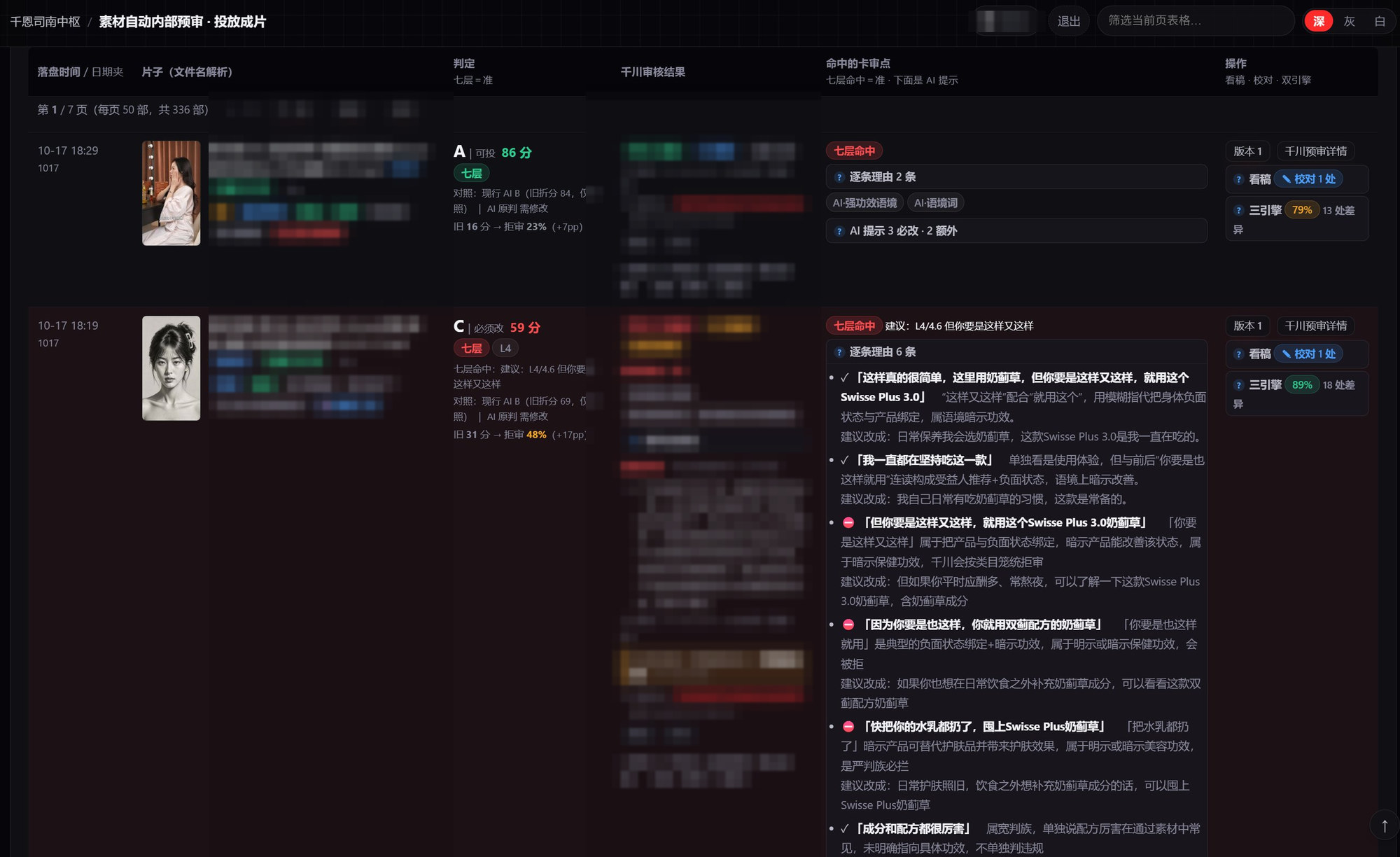
Seven scoring layers plus a re-check against platform rules turn "rejected, no idea why" into "which line, which rule, what to rewrite".
/ Internal Hub — Capability Overview
From creative intake and framework breakdown to compliance scoring, daily media data and report delivery — all inside one interface. This page is a capability overview: accounts, brands and figures are redacted.
/ 01 — Modules
Creatives in, verdicts out, data back. Each module works on its own; together they close the loop.
Seven scoring layers plus a re-check against platform rules turn "rejected, no idea why" into "which line, which rule, what to rewrite".
Two tracks: in-house performance on one side, external structural frameworks on the other. Counted separately, compared structurally.
Paged browsing with on-demand thumbnails; audio-to-visual relations and per-shot voiceover are queryable, so even un-indexed creatives can be judged.
Pulled automatically every day: fields aligned, anomalies flagged. Silent failures surface the same day, not when someone notices.
Chart types locked to a palette, full-page report assembly, deck export — fonts embedded, so it opens offline.
Host-level curves and content-structure attribution side by side — mapped straight to "what to change in the next session".
/ 02 — Workflow
Roles are split by action, not by person. Every step has a defined output, so a problem can be traced to a step.
Creatives ingested, fields cleaned, identities mapped — get the data right first.
Align definitions, then compute spend, ROI, delivery share and concentration.
Charts, full-page reports, decks and finished cuts — all to spec.
Numbers cross-checked, layouts screenshot-verified, cuts frame-scanned. Not done until it passes.
/ 03 — Roles
One role, one job. When scope grows, add a role — never stretch one role to cover everything.
/ 04 — Guards & Self-Improvement
Not discipline — mechanism. Five of the eight are where the model gets sharper with use: verdicts flow back, the lexicon grows, thresholds follow the category.
When the platform's real verdict lands, every line is reconciled into "same spot / same class / missed"; anything missed goes straight into the lexicon, so the next batch won't repeat it. This is where the model corrects itself.
Rejection reasons are mined into sentences automatically, each with its source, hit count and effective date. New entries sit in an observation pool until they have enough samples.
Every re-judgement keeps a version: which line triggered it, which version ruled, how much it changed. Any conclusion traces back to the source text.
Transcription, context ruling and rule matching run independently; divergence beyond a threshold is flagged. Humans only read the disagreements; the rest passes in bulk.
Pass rates differ by category. Scores are calibrated against that category's history plus the account's own baseline — no single ruler for every creative.
The model's "I fixed it" and the independent re-check are recorded separately; when they disagree, the re-check wins. Self-report is not evidence.
Fewer than N shifts or N creatives is labelled "low sample" — no conclusion, no place in the summary. Small samples must not bend the parameters.
Task states are scanned daily; failures surface the same day. When scoring people, market drift and group medians are subtracted first — never book the market's bill to an individual.
Not written in a handbook for people to follow — grown into scripts and tables: gaps raise, drift flags, thin samples stay silent.
/ 05 — Engine
Rules aren't hard-coded — judgement is handed to the model, and nothing is computed until a creative arrives. Every clip is read for voiceover, visuals and batch context before its rules are chosen.
Not fixed-interval sampling. The model picks frames by voiceover pauses and visual changes — a 30-second clip usually needs only 5–8 frames to be judged.
Criteria are generated on the spot, not looked up. The same script under a different category or account yields different risk points — the same sentence judged differently in a different context.
The creative type decides how many chains run: voiceover-only takes two passes, visual creatives three. What it will cost is stated before it runs.
Results land in the library and dashboards immediately and feed the next analysis. While a person reads the output, the next batch is already running.
This page is a capability overview of an internal system. Account names, brand names, creatives and media figures are all redacted: values appear as masks or unscaled placeholders and do not represent any real campaign result. Screenshots match the production layout, but the numbers are not real. For specifics, please get in touch.